


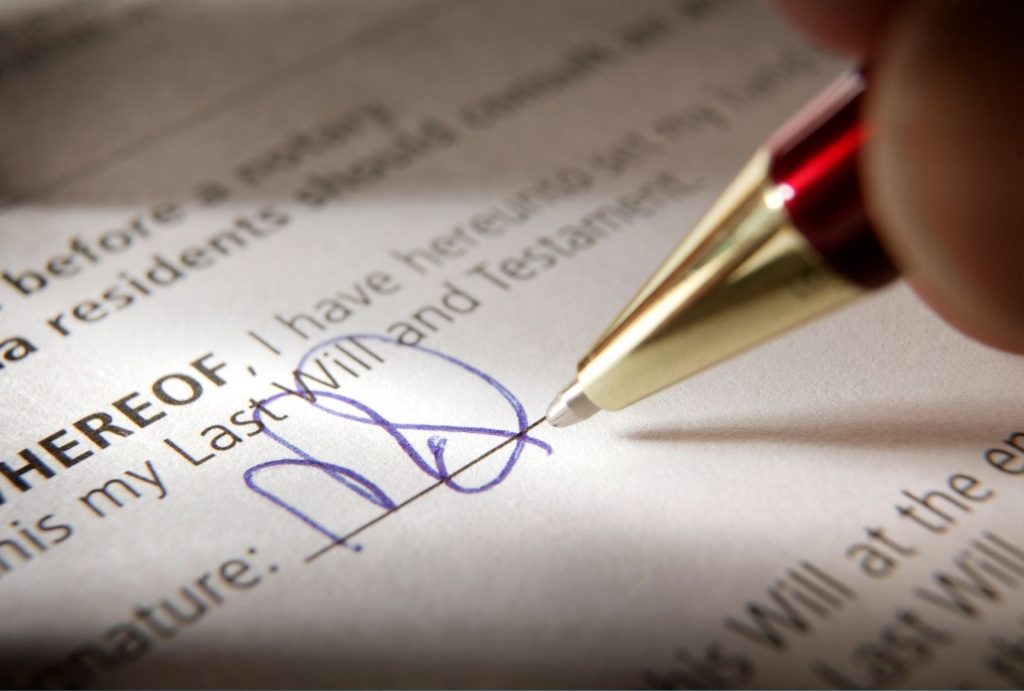
A recent High Court decision serves as an important reminder that, even if a Will appears genuine, it can still be declared invalid if it has not been properly witnessed.
In Batiller v Edwards and others[1], the Court ruled that a Will was invalid because it had not been witnessed by two valid witnesses as required by law. The case highlights just how important the formal execution requirements of a Will are and why they should never be treated as a mere formality.
The Law
Section 9 of the Wills Act 1837 provides that no will shall be valid unless:
- it is in writing, and signed by the testator, or by some other person in his presence and by his direction; and
- it appears that the testator intended by his signature to give effect to the will; and
- the signature is made or acknowledged by the testator in the presence of two or more witnesses present at the same time; and
- each witness either:
- attests and signs the will; or
- acknowledges his signature,
in the presence of the testator.
If these requirements are not met, the Will is invalid, regardless of what the deceased may have intended.
The dispute
The case concerned the estate of Dorothy May Edwards, who died in 2017. A Will dated 24 December 2012 left the residuary estate, including the deceased’s home, to a grandson. However, the Will was challenged on several grounds, including forgery, undue influence and lack of due execution.
The deceased had made an earlier professionally drafted Will in August 2012 which divided her estate equally between her son and daughter. The later Will fundamentally changed those arrangements, making its validity an important issue in the dispute.
The central issue in this case was whether the Will had been properly witnessed.
Both individuals who were said to have witnessed the Will had died before the trial. As a result, the Court had to consider other evidence, including expert handwriting evidence.
While the experts disagreed about the authenticity of the deceased’s signature, the evidence regarding one of the witness signatures was far stronger. The claimant’s handwriting expert concluded that it was highly probable that one of the alleged witnesses had not signed the Will at all.
The judge accepted that evidence and found, on the balance of probabilities, that the signature was not genuine. The Court referred to that witnesses prior admission of forgery with regards to other documents. That finding was enough to determine the case.
The Court concluded that because one of the witness signatures was not genuine, the Will had not been witnessed by two witnesses as required by section 9 of the Wills Act 1837. The judge therefore declared the Will invalid.
This finding meant that the Court did not need to decide the other allegations, including forgery and undue influence. The failure to satisfy the formal witnessing requirements was sufficient on its own to defeat the Will.
Why this case matters
This judgment demonstrates that the Courts take the execution requirements for Wills extremely seriously.
A Will may be vulnerable to challenge where:
- A witness was not present when the Will was signed;
- The witnesses were not present at the same time;
- A witness signature is forged or added later; or
- There is insufficient evidence that the statutory formalities were followed.
Even many years after a person’s death, the Court can investigate the circumstances surrounding the signing of a Will and consider expert evidence where concerns arise.
Batiller v Edwards is a clear warning that a Will is only valid if it complies with the strict requirements of the Wills Act 1837. Having two witnesses is not a box-ticking exercise; it is a fundamental legal requirement.
For a successful challenge based on lack of due execution, it is not enough to simply suspect something went wrong. A claimant will need evidence demonstrating that the Will was not executed in accordance with section 9 of the Wills Act 1837. This may include witness evidence, documentary evidence, inconsistencies in the execution process and/or expert handwriting evidence. If the Court is persuaded that the Will was not properly witnessed, it can declare the Will invalid, potentially resulting in an earlier Will taking effect or the estate passing under the intestacy rules.
[1] [2026] EWHC 2086 (Ch)
How can we help?
Stuart Parris is a Senior Associate in our expert Dispute Resolution team.
If you have any queries relating to the above subject, please contact Stuart or a member of our Dispute Resolution team, who will be able to assist you. Please call 0800 024 1976 or contact us via our online enquiry form.
Contact us